Why remote meetings don't feel the same
Remote meetings often feel oddly incomplete even when nothing obvious has gone wrong. This article looks at the missing cues, tiny delays and attention costs that make video calls land differently.
Share
Checking read-aloud support…
The Agenda Can Be Identical And The Experience Still Feels Off
Most people have had this feeling by now.
You finish a remote meeting, and technically everything was covered. The decisions were made. The updates were given. Nobody said the platform failed. But the call still felt thinner than the equivalent conversation would have felt in person.
That difference is real.
It is not just nostalgia for offices or a refusal to adapt. Remote meetings remove and distort a surprising number of signals that help conversation feel natural.
Tiny Delays Change Turn-Taking More Than We Admit
One of the biggest differences is also one of the smallest: delay.
Even a fraction of a second changes how people read each other.
In person, the rhythm of conversation is fast and overlapping. Someone leans forward, opens their mouth slightly, laughs under their breath, or signals that they are about to jump in. Most of that coordination happens without anybody consciously narrating it.
On a video call, that rhythm becomes more cautious. People pause longer to avoid speaking over each other. Two people start at once, both apologise, then both stop. The conversation becomes more orderly, but also less alive.
That tiny friction adds up.
Eye Contact On Video Is Mostly An Illusion
Another reason remote meetings feel different is that eye contact does not really work the same way.
If I look at your face on screen, I am not looking into the camera. If I look into the camera, I am no longer properly looking at your face. So even when everybody appears attentive, the usual cues around attention and acknowledgement get scrambled.
That matters because eye contact is not only about intensity. It is also how we judge timing, warmth, reassurance and whether someone is truly with us in the conversation.
Remote tools simulate that signal, but they do not reproduce it.
Rooms Carry Side Information That Calls Flatten
In-person meetings contain a lot of side information.
You notice who is settled, who is tense, who has already half-made up their mind, who keeps glancing at the door, who has a page of notes, who came in energised and who came in rushed from something else.
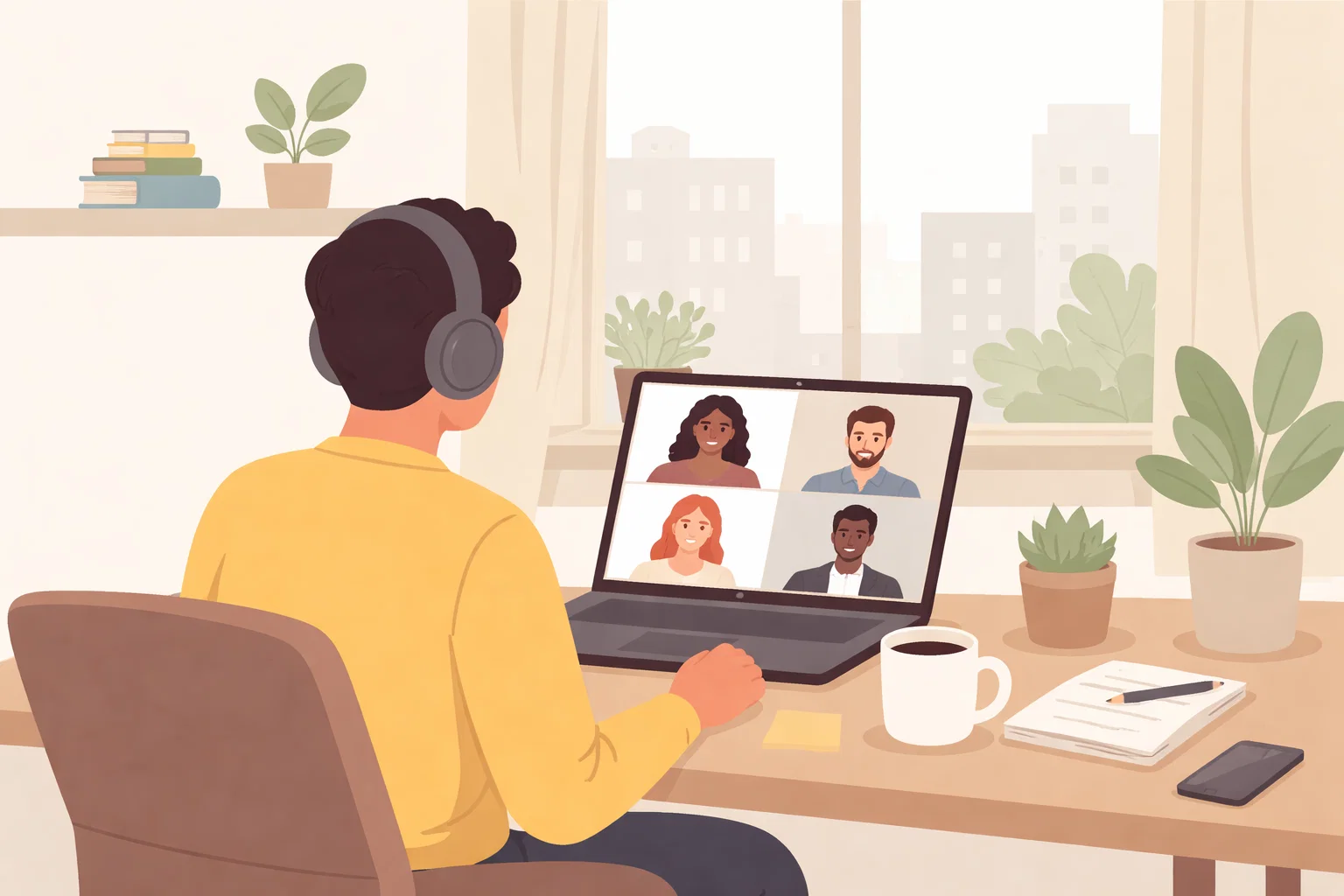
Video compresses all of that into cropped rectangles.
You still see something, of course, but it is a curated slice. Framing, lighting, bandwidth, camera position and mute behaviour all reduce what the room would normally tell you for free.
This is part of why remote calls can produce odd misunderstandings. The words may be clear, but the surrounding context is thinner.
Meetings Used To Have Edges
A physical meeting usually has a before and after.
You walk there. You sit down. You exchange a quick line before things start. You leave together or drift into a shorter follow-up conversation at the door.
Remote meetings often lose those edges.
Instead, one screen disappears and another begins. There is less informal decompression before the topic starts and less natural spillover afterwards. That makes meetings feel more transactional.
Sometimes that is efficient. Sometimes it also means the conversation never quite warms up enough to become useful.
Attention Works Differently On Calls
There is also the issue of divided attention.
On a call, the whole device is full of competing possibilities:
- unread messages
- browser tabs
- notes
- calendar reminders
- the temptation to quietly do two things at once
In a room, social pressure helps keep attention anchored. On a laptop, attention becomes easier to fragment while still looking polite.
That is one reason remote meetings can feel strangely tiring. You are not only following the conversation. You are constantly managing the environment around it.
None Of This Means Remote Meetings Are Bad
I am not anti-remote. Remote meetings solve real problems. They reduce travel, widen access, make quick check-ins easier and allow collaboration that would otherwise never happen.
But I think they improve when we stop pretending they are identical to in-person conversations.
They are a different medium, and different media need different habits.
What Usually Helps
The remote meetings that feel best tend to do a few things deliberately.
They are more likely to:
- have a clear purpose before people join
- stay shorter than an equivalent in-person session
- leave space for one person to finish a thought without panic
- use notes or agendas to reduce memory load
- make the next step explicit before the call ends
And when the meeting matters, it also helps to protect the edges a little. A minute of human conversation before the agenda starts is not wasted time. It often restores some of the texture the platform strips away.
The Real Difference Is Not Technical, It Is Human
Remote meetings do not feel different because people are weaker communicators online. They feel different because human conversation was never built around tiled faces, compressed sound and invisible lag.
We adapt, and often we adapt well. But the medium still shapes the feeling.
Once you recognise that, the strange thinness of some calls starts to make sense.
It is not that nobody cared.
It is that a screen can carry the content of a meeting more easily than it can carry the full social weight of being together.